
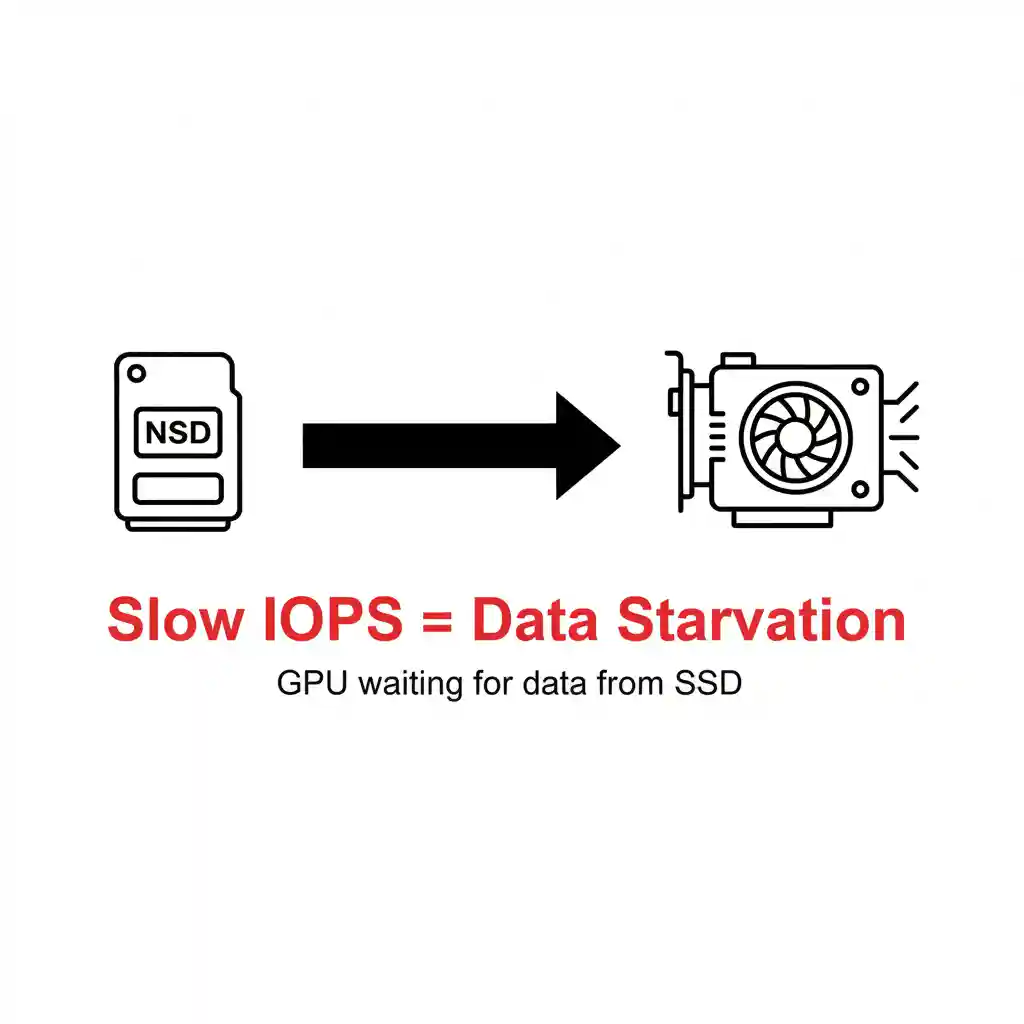

You’ve invested in a powerful NVIDIA RTX 4090 with 24GB of VRAM. You can generate a stunning SDXL image in seconds. But when you try to train your own LoRA model on a custom dataset, your entire system grinds to a halt. The GPU utilization fluctuates wildly, and what should take an hour stretches into an entire afternoon.
If this sounds familiar, you’ve likely encountered the **unseen bottleneck of AI training: your storage.**
At AI Gear Lab, we’ve discovered that for tasks like LoRA fine-tuning, your Solid State Drive (SSD) is often more critical than your CPU. And it’s not about the flashy sequential read speeds you see on the box; it’s about a much geekier metric: **IOPS (Input/Output Operations Per Second).**
Why LoRA Training is an IOPS Nightmare
Generating an image is a linear, predictable task for your GPU. But training a model is different. It involves a chaotic process of data preparation:
- Your system needs to read thousands (or millions) of small image files from your dataset.
- It then processes corresponding text caption files (.txt).
- This data is shuffled, batched, and fed into the VRAM in a pseudo-random order.
This process of rapidly accessing thousands of tiny, non-contiguous files is the definition of a high-IOPS workload. A budget SSD with low random read speeds simply cannot keep up. Your multi-thousand-dollar GPU is left “starving”—waiting for data that is stuck in a storage traffic jam.
Lab Note:
In our tests, switching from a budget SATA SSD to a high-end NVMe drive like the Samsung 990 PRO reduced the “data loading” phase of a LoRA training epoch by up to 70%. The GPU was able to maintain a consistent 95-100% utilization, whereas before it would constantly dip to 30-40% while waiting for the disk.
Sequential Speed vs. Random Speed: What’s the Difference?
Think of it like this:
- Sequential Speed is like reading a book from start to finish. This is what you use when loading one giant 40GB LLM file.
- Random Speed (IOPS) is like finding 10,000 specific words scattered across that entire book. This is what you do during LoRA training.
This is why we prioritize drives with high IOPS in our lab builds.
Hardware Recommendations for Smooth Training
To eliminate the storage bottleneck, your AI workstation needs a tiered storage strategy.
| Component | Our Recommendation | The “Why” |
|---|---|---|
| OS & Software Drive | A decent 1TB NVMe SSD | Fast boot times and application loading. |
| AI Models & Datasets Drive | Samsung 990 PRO (2TB or 4TB) | Top-tier IOPS for training and fast sequential reads for model loading. This is your “work drive”. |
| Archival Storage | A large capacity HDD or SATA SSD | For storing old models and datasets you aren’t actively using. |
Conclusion: Feed Your GPU Properly
Investing in a high-end GPU is only half the battle. To unlock its full potential for AI training, you must ensure it has a high-speed data pipeline. A high-IOPS NVMe SSD like the Samsung 990 PRO isn’t a luxury; it’s a necessity for any serious AI practitioner.
Stop letting your storage be the weakest link. Upgrade your drive, and let your GPU finally run at the speed it was designed for.
Explore our full list of AI-ready storage solutions at the AI Gear Lab.