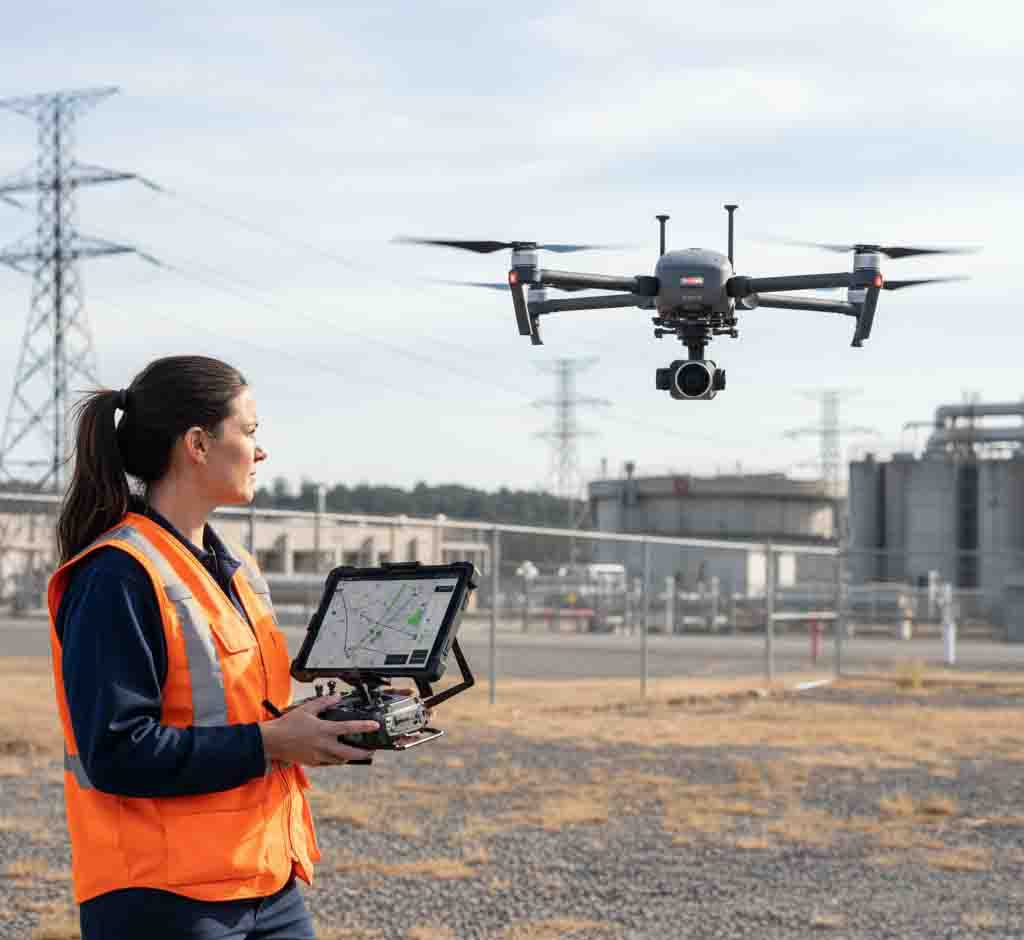
The commercial drone industry is experiencing explosive growth across the United States. It’s no longer a hobbyist domain but the frontier of high-value data acquisition and analysis . Demand from businesses for skilled UAV (Unmanned Aerial Vehicle) operators—ranging from AI-assisted infrastructure inspection to large-scale farm mapping—is rapidly outpacing supply. This guide is a market-tested blueprint designed to help you quickly gain commercial credentials and upgrade your role from a mere “pilot” to a “High-Value Data Consultant,” achieving maximum career return on investment (ROI).
Step 1: The First Step to a High-ROI Career: FAA Part 107 Certification
Your FAA Part 107 Remote Pilot Certificate is your passport to the commercial market. This certification ensures all commercial operators adhere to national airspace safety and accountability standards, forming the foundation for securing high-value contracts.
Minimum Requirements (License to Print Money):
- Be at least 16 years old
- Be able to read, write, speak, and understand English
- Be in a physical and mental condition to safely operate a drone
- Pass the FAA’s aeronautical knowledge test
- Complete the Transportation Security Administration (TSA) security screening
Step 2: High-Efficiency Strategy for the FAA Part 107 Knowledge Test
The Part 107 exam consists of 60 multiple-choice questions, requiring a 70% passing score. Efficient preparation is crucial for a fast career launch.
- Focus on Official Materials: Concentrate on the FAA’s “Remote Pilot – Small Unmanned Aircraft Systems Study Guide.” Core topics include airspace classification, meteorology, loading and performance, and emergency procedures.
- Utilize Practice Test Platforms: Use paid or free online practice exams to identify knowledge gaps and become familiar with the question format. Treat practice tests as a learning tool, not just an assessment.
- Consider High-ROI Training Courses: Many structured courses can cut your study time in half, ensuring you pass the exam on your first attempt.
Key knowledge areas include reading aviation charts, understanding meteorological reports, applying FAA regulations, and managing operational risks.
Step 3: Skill Upgrade from Pilot to Data Specialist (The High-Value Core)
Successful drone professionals no longer rely solely on flight skills. Your core value lies in data processing and business insight.
- Data Processing & Delivery (Highest Value): Develop the ability to use specialized software (e.g., Pix4D or DroneDeploy) to create high-accuracy maps, 3D models, orthomosaic imagery, and inspection reports.
- Professional Applications & Surveying: Master automated flight planning and data acquisition methods used in large-scale projects (e.g., construction site progress, mining volume calculation, solar panel defect detection).
- Flight Proficiency (Base Requirement): Practice manual flying skills, including hovering, orientation control, and emergency procedures in various weather conditions (within regulatory limits).
- Regulations & Airspace Navigation: Understand how to identify controlled airspace, obtain necessary authorizations (e.g., LAANC system), and ensure compliance for every flight.
- Client Communication & Needs Analysis: Enhance professional communication skills to accurately understand project requirements and deliver data outputs in the form of business intelligence reports.
Step 4: Equipment Investment Strategy (Pursuing Efficiency and Professionalism)
Your equipment investment should directly align with the high-value application areas you target.
- Skip the Toy Drones: Invest in a commercial-grade platform with RTK/PPK capability, such as the DJI Mavic 3 Enterprise or Autel Robotics Evo II, for jobs requiring centimeter-level accuracy.
- Key Accessories: Purchase enough spare batteries for high-efficiency field operations (to minimize downtime), ND filters, and high-coverage commercial liability insurance.
- Software is the Real Asset: Allocate your budget toward professional-grade mapping and modeling software (such as the Pix4D mentioned above).
Step 5: Launching Your High-Value Commercial Drone Business
Once certified and equipped, your business strategy must target high-demand, high-margin niche areas.
- Target High-Demand Niches: Focus on precision agriculture, telecommunications tower inspection, infrastructure thermal imaging, or Building Information Modeling (BIM). Avoid the overcrowded, low-price photography market.
- Establish Legal & Insurance Structure: Register a Limited Liability Company (LLC), secure adequate commercial insurance, and develop standardized operating procedures.
- Create Data-Driven Marketing Materials: Build a portfolio website showcasing your data deliverables (3D models, high-accuracy maps), not just aerial photos.
- Targeted Networking: Connect with project managers in construction, engineering, utility, and agriculture sectors.
- High-Value Service Pricing: Research market rates and develop competitive, value-based pricing that reflects the accuracy and depth of the analysis you provide, rather than charging by the hour.
The commercial drone industry offers significant opportunities for professionals who value technology, data, and entrepreneurial flexibility. With the right certification and business planning, you can build a high-ROI career.
My Personal Take (Decades of Insight)
The income potential in the commercial drone industry is no longer determined by how well you can fly, but by how accurate and insightful the data you acquire is. If you want to push this career’s ROI to the max, dedicate 80% of your energy to Step 3: Data Processing and Step 5: Niche Selection. By learning to convert raw drone data into business insights that clients can immediately act upon, you can upgrade your role from a “pilot” to a “Tech Entrepreneur”—the key to income growth over the next decade.
Official Data Sources:
Federal Aviation Administration (FAA) – Part 107 Certification Requirements U.S. Bureau of Labor Statistics (for employment trends)