In the rapidly evolving American workplace, the ability to effectively communicate with artificial intelligence (AI) has transitioned from a niche technical skill to a fundamental professional competency. Prompt engineering—the art and science of crafting instructions to guide AI behavior—is now one of the most valuable and sought-after skills across industries. From Silicon Valley tech giants to Wall Street financial firms, professionals who can reliably harness the power of generative AI are gaining a significant competitive advantage.
This comprehensive guide explores the essential components of AI prompt engineering, providing a structured framework to help you communicate more effectively with AI models, enhance your productivity, and future-proof your career in an AI-driven economy.
Understanding AI Prompt Engineering
Prompt engineering is more than just typing questions into a chatbot. It’s a systematic approach to AI-human communication that involves crafting precise, contextual, and actionable instructions to elicit high-quality, relevant responses from AI models.
In the U.S. business context, where efficiency and measurable outcomes are highly valued, prompt engineering directly impacts productivity. A well-crafted prompt can generate marketing copy indistinguishable from human writing, analyze complex datasets in minutes, or draft technical documentation—saving hours of manual work. Conversely, vague or poorly structured prompts often produce generic, irrelevant, or inaccurate outputs that require significant time to correct.
The economic implications are substantial. According to industry analyses, roles requiring AI prompt engineering skills often command premium compensation, with many organizations creating specialized positions dedicated solely to AI interaction and optimization.
Core Components of Effective Prompt Engineering
Mastering prompt engineering requires understanding several key components that influence AI responses:
1. Clarity and Specificity
AI models process instructions literally. Vague prompts yield vague results. Effective prompts clearly articulate:
-
The specific task or question
-
The desired format and structure
-
Any constraints or limitations
-
The intended audience or tone
2. Context Provision
Unlike humans, AI lacks inherent context about your unique situation. Providing relevant background information significantly improves response quality. This includes:
-
Project objectives and goals
-
Industry-specific terminology
-
Organizational context
-
Cultural considerations (particularly important in diverse U.S. markets)
3. Iterative Refinement
Prompt engineering is rarely a one-step process. The most successful practitioners embrace iterative dialogue with AI, using initial outputs as foundations for refined follow-up prompts that progressively narrow toward optimal solutions.
4. Role-Playing and Persona Assignment
Instructing AI to adopt specific roles (e.g., “Act as a senior marketing director for a tech startup”) often produces more sophisticated, context-aware responses aligned with professional standards and expectations.
A Step-by-Step Framework for Crafting Effective Prompts
Follow this structured approach to significantly improve your AI interactions:
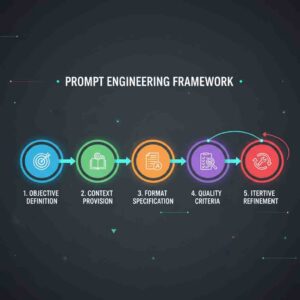
Step 1: Define Your Objective with Precision
Begin by articulating exactly what you want to achieve. Distinguish between different types of tasks:
-
Creative tasks (brainstorming, content creation)
-
Analytical tasks (data interpretation, comparative analysis)
-
Technical tasks (coding, documentation)
-
Strategic tasks (planning, decision support)
Step 2: Provide Ample Context
Offer sufficient background without overwhelming the AI with irrelevant details. Ask yourself: “What would a human expert need to know to address this request effectively?” Include:
-
Industry or domain specifics
-
Organizational objectives
-
Audience characteristics
-
Cultural considerations (especially important for U.S. multicultural markets)
Step 3: Specify Format and Structure Requirements
Explicitly state your expectations for the output format, whether it’s a bulleted list, formal report, executive summary, JSON structure, or email template.
Step 4: Establish Quality Criteria
Define what constitutes success for your request. This might include:
-
Tone and style guidelines (professional, conversational, technical)
-
Depth of analysis required
-
Factual accuracy standards
-
Originality expectations
Step 5: Implement and Iterate
Submit your crafted prompt, then analyze the response. Identify gaps, ambiguities, or misalignments, then refine your approach accordingly in subsequent interactions.
Advanced Prompt Engineering Techniques
Once you’ve mastered the fundamentals, these advanced strategies can further enhance your results:
Chain-of-Thought Prompting
Encourage the AI to articulate its reasoning process by adding phrases like “Think step by step” or “Explain your reasoning.” This approach is particularly valuable for complex problem-solving and educational contexts.
Template-Based Prompting
Develop reusable prompt templates for frequently performed tasks, ensuring consistency and efficiency across similar requests while maintaining high-quality standards.
Comparative Analysis Frameworks
Structure prompts that require AI to compare multiple options against defined criteria, complete with advantages, disadvantages, and situational recommendations.
Constraint Implementation
Use specific constraints to focus AI creativity, such as word limits, style guidelines, exclusion criteria, or structural requirements that prevent meandering or irrelevant responses.
Integrating Prompt Engineering into U.S. Workflows
The most successful American professionals don’t treat AI as a novelty but integrate it seamlessly into their existing workflows:
-
Marketing and Content Creation: Develop brand-aligned content, advertising copy, and campaign strategies with consistent voice and messaging.
-
Data Analysis and Reporting: Transform raw data into insightful reports with actionable recommendations tailored to executive preferences.
-
Software Development: Generate, debug, and document code while explaining technical concepts for diverse audiences.
-
Strategic Planning: Conduct SWOT analyses, market assessments, and initiative planning with comprehensive consideration of relevant factors.
-
Customer Service: Draft response templates, escalation protocols, and communication strategies that balance empathy with efficiency.
The Future of Prompt Engineering
As AI technologies continue evolving, prompt engineering skills will become increasingly sophisticated. Emerging trends include:
-
Multimodal Prompting: Seamlessly integrating text, image, audio, and video inputs in single prompts.
-
Personalized AI Interactions: Systems that learn individual preferences and communication styles over time.
-
Domain-Specialized Prompting: Industry-specific frameworks optimized for healthcare, legal, finance, and other specialized fields.
-
AI-Assisted Prompt Crafting: Tools that help users formulate more effective prompts through guided questioning and suggestion.
Professionals who continuously develop and refine their prompt engineering skills will be best positioned to leverage these advancements, maintaining their competitive edge in an increasingly AI-integrated workforce.
Conclusion: Your Strategic Advantage
Prompt engineering represents far more than a technical skill—it’s a fundamental form of digital-age literacy that enables professionals to harness the full potential of artificial intelligence. By mastering the principles outlined in this guide, you can transform your interactions with AI from frustrating trials into productive, value-creating collaborations.
In today’s competitive U.S. job market, those who can effectively bridge the human-AI communication gap will not only enhance their current productivity but will also position themselves as invaluable assets in the evolving world of work. The time to develop this critical skill is now.
Official Data Sources: U.S. Bureau of Labor Statistics, National Center for O*NET Development