User Experience (UX) Design has emerged as one of the most critical and in-demand fields in the American tech industry. Companies across the United States recognize that superior UX design directly impacts customer satisfaction, retention, and revenue. UX designers create meaningful and efficient experiences for users when they interact with digital products like websites and mobile applications.
This profession combines psychology, design, and business strategy, making it an ideal career for creative problem-solvers. The U.S. Bureau of Labor Statistics forecasts faster-than-average growth for digital design roles, with the median salary for UX designers often exceeding $85,000 annually, and senior roles in tech hubs like San Francisco or New York can command over $120,000.
This comprehensive guide outlines the education, skills, and strategies you need to build a successful career as a UX designer in the United States.
What Does a UX Designer Actually Do?
A UX designer’s primary goal is to enhance user satisfaction by improving the usability, accessibility, and pleasure provided in the interaction between the user and a product. Daily responsibilities often include:
-
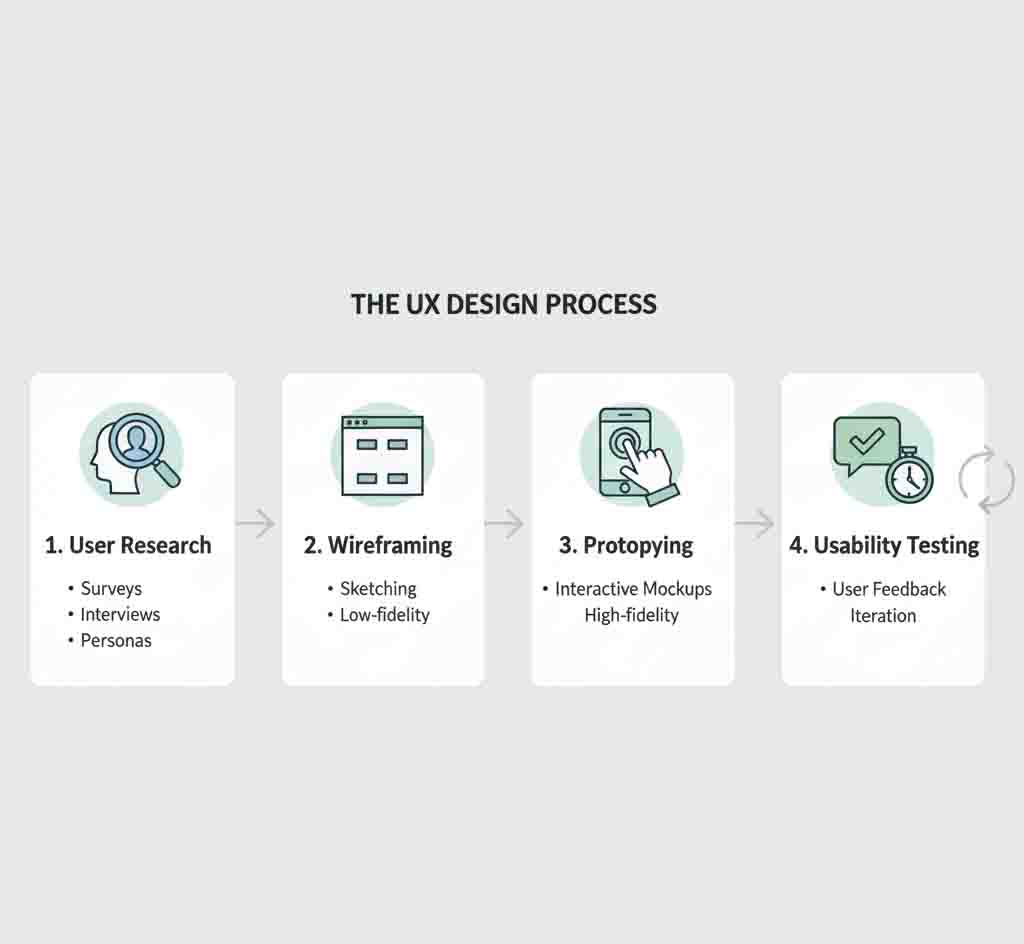
User Research: Conducting interviews, surveys, and usability tests to understand user behaviors, needs, and motivations.
-
Information Architecture: Organizing and structuring content in a way that helps users navigate intuitively.
-
Wireframing and Prototyping: Creating blueprints and interactive models of products to demonstrate functionality before development.
-
Collaboration: Working closely with UI designers, developers, and product managers to ensure a cohesive product vision.
In the U.S. workplace, UX designers are expected not only to execute designs but also to clearly articulate and defend their design decisions using data and user feedback, a reflection of the culture that values initiative and direct communication-2.
Essential Skills for a UX Designer in 2025
To succeed as a UX designer, you need a blend of technical (hard) skills and interpersonal (soft) skills.
Technical Skills (The “Hard Skills”)
-
Design and Prototyping Tools: Proficiency in industry-standard tools like Figma, Sketch, or Adobe XD is a fundamental requirement for creating wireframes and prototypes.
-
User Research Methodologies: You must know how to plan and conduct various forms of user research, synthesize the findings, and translate them into actionable design insights.
-
Information Architecture and Wireframing: The ability to structure complex information clearly and create low-fidelity wireframes is crucial for laying the foundation of a successful product.
-
Basic Understanding of UI Principles: While distinct from UX, a grasp of User Interface (UI) design principles, such as visual hierarchy and typography, is increasingly valuable.
Interpersonal Skills (The “Soft Skills”)
-
Emppathy: The core of UX design is understanding the user’s perspective.
-
Communication and Collaboration: You must be able to present your ideas clearly, accept feedback, and work effectively in a team, often in a cross-functional environment-2.
-
Problem-Solving: UX is about identifying user problems and crafting innovative solutions.
-
Adaptability: The tech landscape evolves rapidly, and the ability to learn new tools and methodologies is essential for long-term success.

Educational Pathways to UX Design
You don’t necessarily need a traditional four-year degree to break into UX design, but structured education can provide a strong foundation.
-
University Degrees: A bachelor’s degree in fields like Computer Science, Psychology, Graphic Design, or Human-Computer Interaction (HCI) is a common path. Master’s degrees in HCI or UX Design are highly valued for competitive roles.
-
Bootcamps: Intensive, short-term UX design bootcamps (typically 12-24 weeks) are a popular alternative. They focus on portfolio-building and practical skills, with many offering career support. This can be an excellent choice for career-changers.
-
Self-Directed Learning: Many successful designers are self-taught, using online platforms like Coursera, Udemy, and LinkedIn Learning. The key to this path is building a strong portfolio to demonstrate your skills.
Building a Competitive UX Portfolio
In the U.S. job market, your portfolio is more important than your resume. It is the primary tool recruiters use to assess your skills and design thinking process.
A powerful UX portfolio should include 3-5 detailed case studies that walk through your design process for each project. For each case study, be sure to:
-
Explain the Problem: What user problem were you trying to solve?
-
Show Your Process: Include your research, sketches, wireframes, and iterations.
-
Display the Solution: Present high-fidelity mockups and an interactive prototype.
-
Demonstrate the Impact: Whenever possible, use metrics to show how your design improved key performance indicators (e.g., increased user engagement, decreased support tickets).
The UX Designer Job Search Strategy
-
Resume and Online Presence: Tailor your resume to highlight UX-specific skills and project experiences. Maintain an active, professional LinkedIn profile and a personal website to host your portfolio.
-
Networking: The U.S. tech industry highly values networking. Attend local tech meetups and industry conferences (or virtual events). Connect with other designers on LinkedIn; many are willing to offer advice and may even provide referrals-2.
-
Interview Preparation: UX interviews often include a portfolio presentation where you walk through 1-2 case studies, a whiteboard challenge (designing a solution for a given problem on the spot), and behavioral questions focused on teamwork and problem-solving.
Career Advancement and Future Trends
Starting as a junior UX designer, you can progress to senior designer, lead designer, and eventually UX director or head of design. Some designers specialize in areas like UX research, interaction design, or voice design, while others transition into related fields like product management.
To future-proof your career, stay informed about emerging trends such as AI-assisted design tools, accessible and inclusive design, and design for augmented reality (AR) and virtual reality (VR).
Conclusion: Your Path to a UX Career
Becoming a UX designer requires dedication to learning a diverse skill set and a commitment to understanding user needs. By selecting the right educational path, building a compelling portfolio, and leveraging effective job search strategies, you can position yourself for a successful and rewarding career in this dynamic field. The journey involves continuous learning, but for those passionate at the intersection of technology, psychology, and creativity, it is a highly fulfilling profession.
Official Data Sources: U.S. Bureau of Labor Statistics