The drone industry is rapidly expanding across the United States, creating high demand for skilled Unmanned Aerial Vehicle (UAV) operators. From film production and agriculture to infrastructure inspection and emergency response, commercial drone applications are transforming multiple industries. For American professionals, mastering drone piloting represents a valuable technical skill with immediate career opportunities and entrepreneurial potential.
Core Skills for Commercial Drone Operations
Becoming a proficient drone pilot requires a blend of technical knowledge, regulatory understanding, and practical abilities:
-
Airspace Navigation & Safety Protocols: Understanding FAA airspace classifications (Class B, C, D, E, G) and implementing safety checklists before every flight. This includes checking weather conditions, verifying NOTAMs (Notices to Airmen), and maintaining visual line-of-sight with your aircraft.
-
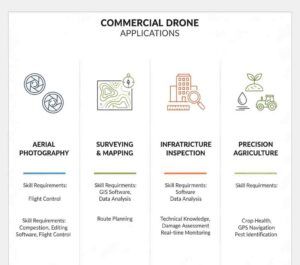
Aerial Photography & Videography: Mastering camera settings (ISO, shutter speed, aperture) for different lighting conditions and composing shots that meet commercial client specifications for real estate, events, and inspections.
-
Mapping & Surveying Techniques: Operating specialized software for photogrammetry, creating 2D maps and 3D models for construction, agriculture, and land surveying applications.
-
Data Processing & Analysis: Using software like Pix4D or DroneDeploy to process captured imagery into actionable data for clients in various industries.
-
Preventive Maintenance & Troubleshooting: Performing pre-flight checks, diagnosing common issues, and understanding when to ground equipment for safety reasons.
FAA Certification: Your Gateway to Commercial Operations
In the United States, commercial drone operations require FAA Part 107 certification. This federal mandate reflects the serious responsibility of operating aircraft in shared airspace:
-
Knowledge Test Preparation: The 60-question exam covers airspace classification, weather, loading and performance, and FAA regulations. Structured study using official FAA materials is essential for success.
-
Operational Limitations Understanding: Part 107 governs flight altitudes (maximum 400 feet AGL), daylight operations, and speed restrictions that commercial operators must memorize and apply.
-
Regulatory Compliance: Maintaining records, reporting accidents, and understanding waiver processes for operations that exceed standard limitations.
The certification process embodies American cultural values of standardization, accountability, and safety consciousness in professional environments.
Specialized Applications by Industry
Drone skills apply across numerous sectors, each requiring specific technical approaches:
-
Construction & Infrastructure: Monitoring progress, creating topographic maps, and inspecting structures like bridges and cell towers while documenting findings for engineers.
-
Agriculture: Using multispectral sensors to monitor crop health, identify irrigation issues, and optimize pesticide application through precise data collection.
-
Public Safety: Supporting search and rescue operations, documenting accident scenes, and assessing damage after natural disasters while coordinating with ground teams.
-
Media & Entertainment: Capturing cinematic footage that tells compelling stories while adhering to strict production schedules and creative direction.
Practical Skill Development Path
Follow this structured approach to build your drone piloting capabilities:
-
Start with Basic Flight Training: Practice with an entry-level drone in open areas, mastering orientation, hovering, and basic maneuvers before advancing to complex operations.
-
Study for Part 107 Certification: Dedicate 3-4 weeks to structured preparation using FAA materials and online practice tests to ensure comprehensive understanding.
-
Build Specialized Experience: Volunteer for community projects or assist established operators to gain hands-on experience with different drone types and applications.
-
Invest in Professional Equipment: Transition to commercial-grade platforms with better cameras, longer battery life, and more stable flight characteristics as your skills advance.
-
Maintain Currency: Stay updated on regulation changes, software updates, and emerging technologies through industry publications and professional networks.
American employers particularly value this combination of formal certification and practical experience, viewing it as evidence of both technical competence and professional dedication.
Future Trends & Career Opportunities
The drone industry continues evolving with several developments that will shape skill requirements:
-
Beyond Visual Line of Sight (BVLOS) Operations: As regulations adapt, pilots will need training for flights where the aircraft isn’t directly visible, requiring enhanced situational awareness.
-
Automated Inspection workflows: Programming drones to follow precise repeatable routes for routine infrastructure inspections, blending piloting with data science skills.
-
Integration with AI Analytics: Using artificial intelligence to automatically identify patterns and anomalies in captured data, creating higher-value services for clients.
Professionals with verified drone skills can pursue roles as independent commercial operators, imaging specialists, UAV operations managers, or inspection consultants across multiple industries.
Official Data Source: U.S. Bureau of Labor Statistics (for occupational context and industry growth patterns)